
Five Things to be Skeptical About with Skeptics…
The intellectual history of the world would be very different if we didn’t have
the rise of skepticism. The practice of challenging conventional wisdom and dogma probably goes back to the earliest humans questioning the wisdom of their leaders who thought it best to stay in trees, eat bananas, and walk on all fours. So we’re very fortunate to have the historical record of leading thinkers like Agrippa the Skeptic, Al Hazen, Lao Tze, Rene Descartes, David Hume, Immanuel Kant and the legions of unknown souls who asked the hard questions to break open dogmas and mind-shackling superstitions.
We have continued to count on skeptics to keep the religious, new agers, hucksters, shady business people, and even scientists in line with their laser-like doubts. However, who keeps the skeptics in line? Are there limits to what skeptics can tell us? Well, actually, yes.
Here’s a list of five things that most skeptics won’t freely admit in a public debate. In fact, they could almost seem to parallel Agrippa the Skeptics “five grounds of doubt” or tropes. These tropes are supposed to make clear that it’s impossible to know anything with certainty. However, it seems some skeptics seem to forget this in their oft-zealous pursuit of the truth.
1. Skeptics are very good at asking questions, but not so hot with answering them.
Although it can be enlightening to ask, “How do you know what you claim to know?” it also can get annoying fast and degenerate into playground one-upmanship. In general, skepticism picks away at holes in dogmas so what we commonly accept as true doesn’t escape examination of their claims.
For instance, reformer Martin Luther questioned the commonly accepted notion that you had to beat yourself to an insane degree in order merit God’s good grace. However, he stopped at questioning how one knew whether she had received God’s good or not. There’s probably no way to prove that since proof of God’s grace was more heart-felt and subjective. It was sincerely a matter of faith and not diligent inquiry, per se. Yet his skepticism changed hundreds of millions of people’s lives.
Likewise, it doesn’t mean that when we can’t answer certain questions that we must accept commonly accepted beliefs. For instance, when science advocate Bill Nye couldn’t answer a question about the origin of consciousness in a recent debate with creationist Ken Ham, Mr. Ham seemed vindicated in saying that consciousness only comes from God. That was silly. Questions are the roads by which we get to answers, not necessarily the answers themselves.
2. Empiricism and scientific inquiry aren’t the only ways to establish proof and very few proofs are final.
It’s become commonplace for secular skeptics to require empirical proof for what’s believable, but historically much of skepticism wasn’t empirical or scientific at all. It’s as if we think the scientific method can be applied to everything. There are two problems with this kind of thinking. The first problem is that if you look at the history of the scientific method, it was a form of thinking rationally about doubt especially as it pertained to the natural world. It never was meant to have a blanket application to everything, especially to what was supernatural or theological. Interestingly enough, the two men revered as the “fathers” of the method, Al Hazen and Roger Bacon, were both devoutly religious people. For men and women like them, the scientific method was a means of understanding the handiwork of a creator, not necessarily the wholesale dismissal of what couldn’t be seen.
The other problem is that proof doesn’t work for everything. In fact, it doesn’t work with most things. For instance, a proof in mathematics can be very different from anything at which we could arrive using a method of experimentation, as quantum physics has made abundantly clear. Proof also meant different things for skeptics like David Hume or Kant, and something completely different for rhetoricians and logicians like Aristotle. In much of religious history, proof was based on original sources, whether those were from scripture, historical record or established religious leaders. A similar issue comes up for historiographers, too.
Actually, there’s not a lot of proof for much of what we use in human culture. For instance, you can prove that it’s a particular time and date, but there’s no “objective” way to prove why the measure of time we use is correct or the best measure of time. A week could have been easily 10 days (as it was for the Egyptians) or three days (as it was in a Basque part of Spain). Yet very few will debate the validity of the idea of a week when they have a day off from work!
3. Human behavior and the arts don’t work like your chemistry set or your engineering formulas.
Although there’s a replicable and correct formula to understand and manipulate inanimate objects, it’s a completely different ballgame for animated subjects. When we leave the study of objects from the natural sciences, we enter into the subjective realm of the social sciences and humanities. Although people are part of the natural world, we might not act like it, or we have a more complex way of understanding ourselves than how we describe igneous rocks.
Skeptics seem to forget that whole other part of science is qualitative, an approach focused on an analysis of the quality of subjective experiences, not only quantitative, that is focused on empirical and observable data. This is true for many fields like psychology, sociology, anthropology, and economics, although these fields also use numbers, data and detailed research like the hard sciences of physics or biology. Nonetheless, it’s hard to describe the experience of racism or mental illness purely by numbers or biology, though many try.
The arts, on the other hand, seem completely subjective. Each generation seems to have its own vision of what is good art and its art may be no less moving or real for people. Some works of art seem timeless and treasured for many generations like Da Vinci’s Mona Lisa or Shakespeare’s tragedies; but how else can we explain that Seinfeld was a #1 hit show for over 10 years, a show that by the admission of its own creators was about…nothing?
There’s another glitch that many skeptics overlook in proclaiming certain fields of study sciences or pseudo-sciences: what makes a field a science? For instance, you can get either a Bachelor of Science or Bachelor Arts in disciplines like psychology or economics, but it all depends on the particular university and its requirements for the degree. There’s no uniform, objective measure that fits the nature of the field itself. It’s hard to argue for the complete objectivity of fields where humans are the subject of study, the conductors of studies, the creators of instruments used in studies and the interpretators of the research. So just how objective are we? It would seem we’re more intersubjective than objective.
4. A skeptic’s backstory doesn’t nullify his or her arguments, but it can either be a barrier or bridge to understandin
An ad hominem attack unfairly and irrationally uses the personal history or issues of a person against that person’s argument, like saying an argument against murder by a killer is invalid because that person is a murderer. However, a person’s history may explain what informs his or her opinion. This is important because it tells you how someone may argue, not dismiss his or her arguments out of hand. For instance, if there’s a recovering alcoholic vehemently making a sound argument against having alcohol at the next office party, a fellow office mate may not be able to knock the argument but he can better understand and cope with the alcoholic’s plight. This is where skeptics and those they doubt can begin to have dialogue that is more humane rather than endless, frustrating debates.
Author and Skeptics Society founder Michael Schermer is a former evangelical Christian. The late atheist and anti-religious journalist Christopher Hitchens’s mother died after a suicide pact with her boyfriend, a reverend who was down on his luck. One can’t help wonder if the zeal in which these men have attacked faith and the metaphysical are informed by their own personal misgivings about their journeys with people of faith. Often when people stop being zealots of one thing, they become zealots of something else. Again, a skeptic’s backstory doesn’t negate his or her arguments, but it also doesn’t free them of bias. A person with a broken heart speaking on the fallacies of love may make solid arguments against love, but we also have ample reason to suspect the motive for their arguments.
However, there are ways to form bridges between faith and doubt without going to extremes, such as Chris Stedman has done in his book, Faithiest. In his book, he chronicles his life from being an evangelical Christian to an openly gay atheist who now seeks to bridge gaps of understanding and respect between people of faith with atheists.
5. Atheism isn’t the only response to being skeptical about God and metaphysics.
In asking their questions and desire for all things to have empirical proof, skeptics would have you think that the only reasonable option of belief for a reasonable or sane person is atheism. This isn’t true at all, even by humanist standards. Skepticism makes clear that one has to prove, on some basis, why something is true. However, an inability to prove something as irrefutably true does not make it automatically false. For instance, I can’t prove that an alien from the planet Vulcan didn’t write this article using some form of advance thought projection into my mind. The best I can say is that given our known understanding of how writing happens, this isn’t likely. However, I can’t offer any irrefutable proof, and neither can a skeptic contrariwise. There are more than a few ways to establish an opinion without empirical data or relying on methods used by the physical sciences.
For instance, take a look at Pablo Stanley’s chart below that shows the various ways by which to manage the absence or presence of evidence for a god:
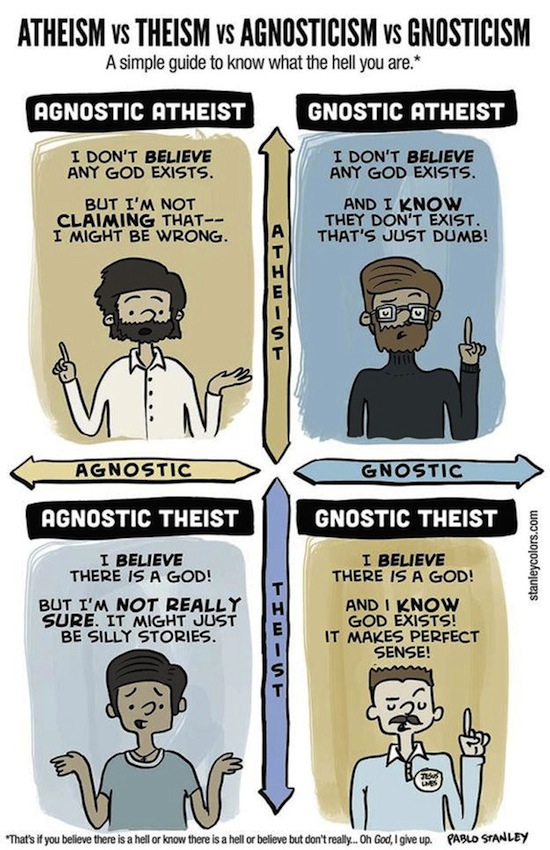
In fact, from that table there are people who certainly know something…or not. A skeptic is a person who challenges what many accept as certainties without sufficient proof. However, it appears many skeptics, especially when it comes to the softer, more humanities-oriented aspects of knowledge and life, whether we’re talking astrology or anthropology, would have to admit that there’s not a lot we know for certain, including how we come to know what we know. That’s where many skeptics get it wrong—and that’s where we should be, well, skeptical.
Ron
Category:
Opinion Tags: Agrippa the Skeptic, astrology, David Hume, empiricism, Immanuel Kant, Lao Tze, Martin Luther, Michael Schermer, Rene Descartes, scientific inquiry, skeptics, supernatural, tropes