
Peru: One Day Without a President
by Ana Andrade
Over the past decade, Peru has experienced a prolonged cycle of presidential instability. Yet the most recent event presents an especially striking symbolic convergence: the removal of the president occurred on 17 February 2026, the very day of a Solar Eclipse.
In mundane astrology (1), Solar Eclipses have long been associated with crises of leadership. The Sun represents sovereignty, executive power, and visibility; its temporary obscuration by the Moon signifies interruption, destabilization, or challenge to authority. Historically, eclipses falling near sensitive points in a national chart have coincided with the weakening, displacement, or transformation of rulers.
The eclipse of 17 February 2026 (28 Aquarius) formed a tight square (90 degrees, challenging, stress) to Uranus (27 Taurus). Aquarius carries associations with reformist impulses, while Uranus — planet of disruption, rupture, and sudden reversal — intensifies the potential for abrupt change. The square aspect introduces tension and instability, often correlating with events that unfold rapidly.
On that same day, the former President José Jerí was removed from office (2). The election of his successor took place on 18 February 2026 at 18:00. Consequently, Peru experienced approximately twenty-four hours without a sitting president — a rare and symbolically charged interval in the life of a nation.
For the purposes of this analysis, the natal chart of Peru is set for 28 July 1821, 10:55:04 LMT, Lima. (3) In this radix chart (4), the Sun is located at 5 Leo, the Moon at 29 Cancer, and the Ascendant at 23 Libra. Although no natal planets occupy Aquarius, the eclipse degree opposed (180 degrees) Venus (23 Leo), ruler of the Ascendant. Venus, as chart ruler, signifies the national identity and governing equilibrium. The opposition suggests tension affecting leadership and institutional balance. However, this factor alone does not fully explain the intensity of the event.
Greater coherence emerges when incorporating the Secondary Progressed chart — a symbolic technique equating one day after birth with one year of development — together with the transits on the eclipse date.
The Secondary Progressed chart for 17 February 2026 reveals the Progressed Sun (29 Aquarius) conjunct the Lunar North Node (25 Aquarius). This conjunction emphasizes a pivotal evolutionary moment in the nation’s trajectory. The Progressed Sun, symbolizing the evolving executive principle, stands at the anaretic (5) 29th degree — traditionally considered a degree of culmination, urgency, and transition.
This Progressed Sun forms an opposition to Progressed Mars retrograde (0 Virgo), which is conjunct both the Vertex (29 Leo) and the Lunar South Node (25 Leo). Mars retrograde suggests internalized conflict, repressed tension, or unresolved confrontation. The conjunction with the South Node and Vertex amplifies the sense of fated interruption. The Vertex, often linked to sudden or externally triggered events, reinforces the perception of inevitability.
The configuration becomes significantly intensified by transiting Uranus in Taurus. Uranus forms a square to the eclipse degree, thereby squaring the Progressed Sun, while simultaneously squaring the Progressed Mars and Vertex. Uranus thus becomes the focal planet of a T-Square (6) configuration — two squares and one opposition — creating acute dynamic tension. In mundane terms, such a configuration frequently correlates with abrupt structural shifts and unexpected institutional rupture.
Particularly striking is the near-exact overlay between the eclipse degree (28 Aquarius) and the Progressed Sun (29 Aquarius). The eclipse effectively darkens the Progressed Sun, symbolically obscuring the nation’s executive function. The one-degree separation between them corresponds remarkably well with the one-day interval during which Peru remained without a president.
From a symbolic perspective, this event reflects not merely political instability but a brief suspension of executive authority that mirrors the astronomical obscuration of the solar principle. The eclipse did not simply coincide with the removal of a leader; it activated a progressed culmination point already primed for transformation. Uranus supplied the catalytic force.
Thus, the twenty-four-hour absence of presidential authority can be understood as the temporal manifestation of a precise celestial alignment — a moment when the solar archetype of leadership was both literally and symbolically eclipsed. Fortunately, despite this temporary vacuum of executive power, the economic impact remained minimal, and the interruption did not translate into broader financial instability. The markets absorbed the transition with relative stability, suggesting that while the symbolic dimension of the event was striking, its material consequences were contained.
Notes: (1)Mundane astrology refers to the study of world events, as opposed to personal horoscopes.
(2) https://apnews.com/article/peru-president-removal-jeri-elections-explainer
8acebfea62771ef77545652b41fd4201
(3)Juan Estadella, Notas de un Astrólogo. https://juanestadella.com/libros.html
(4) Radix in astrology refers to the root, foundation, or original birth chart (natal chart) of an individual or event.
(5) The anaretic degree is the 29th degree of any zodiac sign, commonly known as the “degree of fate” or “karmic degree.” It signifies a point of crisis, intense pressure, and urgency, often representing a final, crucial lesson or a necessary ending in the life area ruled by the planet or house involved.
(6) A T-Square is a dynamic pattern composed of two or more planets in opposition (180 degrees), each squared (90 degrees) a third. It represents stress and conflict, with the fulcrum point (at the square) offering a possibility of resolution.
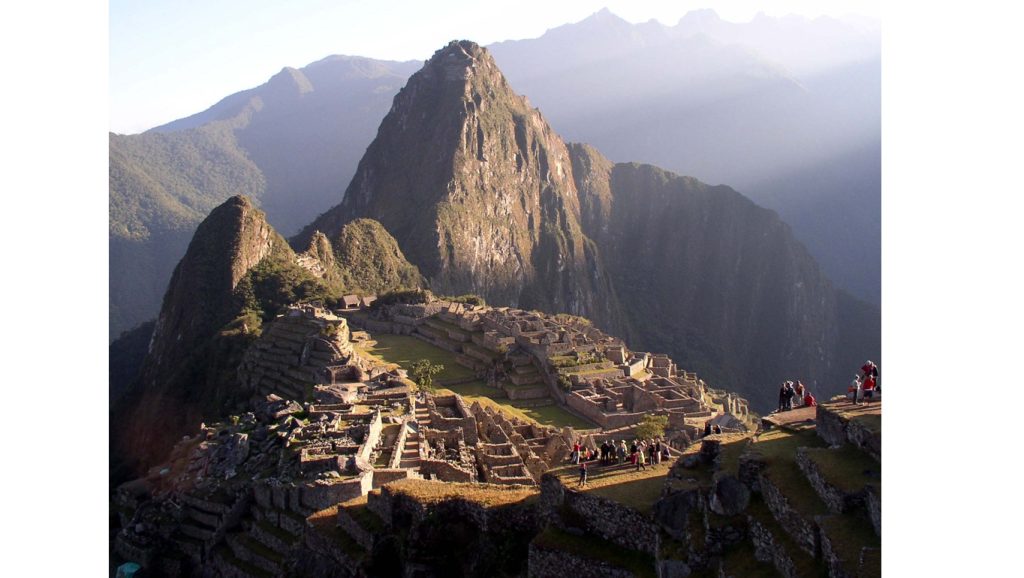
Title Image Credit: Image of Machu Picchu from Wikimedia Commons
YoTuT, CC BY 2.0 <https://creativecommons.org/licenses/by/2.0>, via Wikimedia Commons
Ana Andrade is an astrologer from Peru and the International Delegate for the National Council for Geocosmic Research (NCGR), Peru. She holds the ISAR-CAP certification and the Practitioner’s Level Certification in Horary Astrology granted by the School of Traditional Astrology (STA).
Ana has delivered lectures internationally, including at the Astrological Association of Great Britain (AA), the Astrological Lodge of London (UK), UAC 2018 in Chicago (USA), the Krishnamurti Institute of Astrology (India), and the AstroArt School of Astrology (Turkey). She has also participated in Cosmic Intelligence Agency, AA, NCGR, STA, AOAUK, Kepler College, ISAR Turkey, Deneysel Astroloji Akademi, Synchronicity University, San Francisco Astrological Society.
Ana has articles published in Astrodienst, Timelords magazine, Astrology News Service, OPA (English and Spanish), and co-authored in publications by ISAR and AFA.
Contact: astroanaandrade@gmail.com
Facebook: Ana Andrade
Instagram: @anaandrade8080
https://astroanaandrade.wordpress.com
Category:
News Tags: anaretic degree astrology meaning, AP News Peru president removal, Aquarius reformist energy politics, astrology and politics Peru, astrology of leadership crisis, celestial alignment political events, constitutional crisis Peru 2026, eclipse and executive power, eclipse square Uranus interpretation, economic stability during political crisis Peru, executive authority eclipse symbolism, geopolitical astrology South America, Lunar Nodes political destiny, Machu Picchu Peru symbolic image, mundane astrology Peru, national chart Venus opposition eclipse, Peru governance transformation, Peru government transition February 18 2026, Peru independence chart 28 July 1821 Lima, Peru institutional rupture, Peru leadership crisis February 2026, Peru markets reaction political change, Peru natal chart analysis, Peru one day without a president, Peru political crisis 2026, Peru presidential instability, Peru presidential removal 17 February 2026, Peru progressed chart February 2026, Peru Solar Eclipse February 17 2026, Peru without president 24 hours, political astrology analysis 2026, Progressed Mars retrograde opposition, Progressed Sun conjunct North Node, removal of President José Jerí, Secondary Progressed Sun 29 Aquarius, solar archetype eclipsed, Solar Eclipse 28 Aquarius, T-Square astrology configuration, Taurus Uranus disruption, Uranus in Taurus political upheaval, Uranus square Solar Eclipse 2026, Vertex astrology sudden events, world events astrology February 2026