Lula Elected President of Brazil
By Ana Andrade
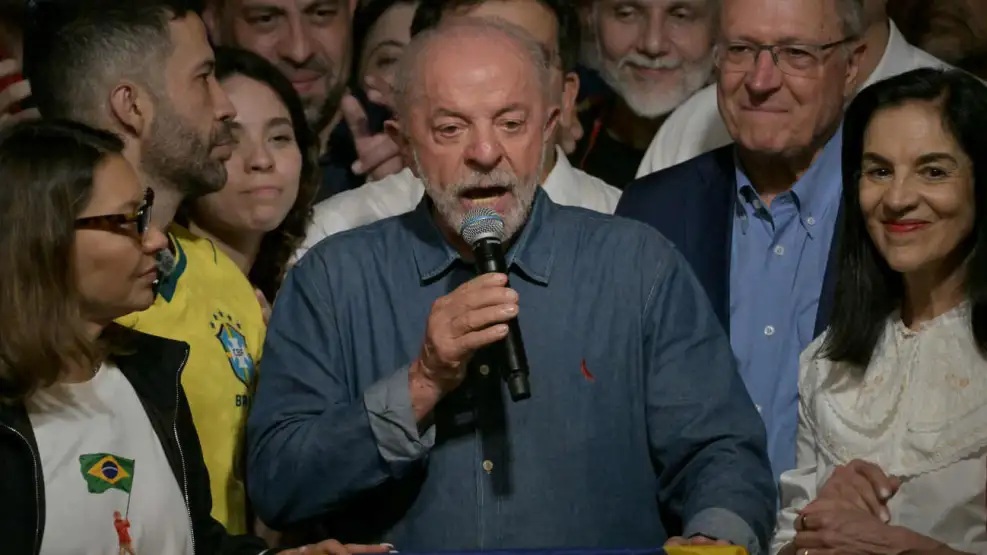
On October 25, Luiz Inácio Lula da Silva, Brazil’s president, achieved a dramatic electoral comeback, defeating his opponent, Flávio Bolsonaro. This will be a historic fourth term in office. Lula, 80-year-old left-wing leader, received 51.79% of the vote, compared with 48.21% for his 45-year-old rival. Bolsonaro called for the results to be annulled. Lula had lost the first round of the election to Bolsonaro on October 4. (1)
Before the second round, many observers expected Bolsonaro to win. Yet the outcome unfolded differently. How did Lula manage this comeback?
First, more than three million additional people voted in the second round than in the previous one, representing a significant increase in voter participation. (1)
Second, during the second presidential debate on October 23, Lula confronted Bolsonaro over the insulting “nine fingers” remark. Bolsonaro had declared that Lula “gives with one hand and takes away with nine fingers,” referring to Lula’s physical disability, the loss of a finger in a workplace accident.
Lula responded “I will not allow a militiaman to call me nine fingers,” and continued “If there’s anyone here who knows what it means to work, it’s me.”, highlighting his words which drew a clear distinction between his own working history and Bolsonaro’s. Lula demanded an apology, which Bolsonaro subsequently offered. (2)
Lula also addressed maternity leave legislation. Bolsonaro acknowledged that he had been wrong to vote against extending maternity leave, adding that he would vote differently if given the opportunity today. (2)
Brazil is a crucial economic partner, both within the region and globally. As South America’s largest country—and the only Portuguese-speaking nation in the region—it is practically a continent within a continent, with its own distinctive political, cultural, and economic characteristics.
Against the backdrop of a broader rightward shift in several South American countries, Lula’s election represents the continuation of a left-wing political project that seeks to defend the interests of the population, protect the Amazon rainforest—one of the planet’s most important ecological systems—and safeguard the country’s natural resources.
His victory also represents a challenge to ultra-right-wing political agendas that, from this perspective, risk treating South American nations as an extension of US strategic interests rather than as sovereign countries with their own priorities and aspirations.
Astrologically speaking, the planetary transits during the second round offer an intriguing astrological perspective on the election and its unexpected outcome.
In the national chart of Brazil (3), it is found that transiting Mercury retrograde (20 Scorpio) was exactly conjunct Brazil’s Midheaven. The transiting Sun (2 Scorpio) was conjunct Brazil’s natal Mars (3 Scorpio), the ruler of the country’s Midheaven. Meanwhile, transiting Neptune retrograde (2 Aries) was conjunct natal Pluto (0 Aries), while Uranus retrograde (4 Gemini) was moving toward a conjunction with the natal Moon and Jupiter (both at 6° Gemini).
In the chart of Lula da Silva (4), the transiting Sun (2 Scorpio) was conjunct Lula’s natal Sun (3 Scorpio), highlighting a significant moment in his personal and political trajectory. Transiting Mercury retrograde (20 Scorpio) was conjunct his natal Mercury (19 Scorpio), emphasizing communication, incisive debate, and the reconsideration of previous positions. At the same time, transiting Pluto (3 Aquarius) was square his natal Sun, suggesting a period of profound transformation, intense power struggles, and the potential redefinition of his political role.
In the chart of Flávio Bolsonaro (5), transiting Neptune retrograde was opposing his natal Saturn retrograde (4 Libra) and Jupiter (1 Libra). Transiting Jupiter (23 Leo) was trine his natal Neptune retrograde (24 Sagittarius), while transiting Mercury retrograde (20 Scorpio) was opposing his natal Venus (16 Taurus). At the time of the election, Mercury—the ruler of Bolsonaro’s Midheaven—was retrograde. From an astrological perspective, this symbolism invites reflection on political communication, public image, and the possibility of unexpected reversals.
Finally, a special emphasis on retrograde periods of planets, especially those that are personal, such as Mercury and Venus, invite to revisit, reconsider, review, and reformulate the situation. Rather than assuming that circumstances will unfold as expected, they encourage us to question our assumptions and remain open to changing conditions.
In this election, the retrograde motion of Mercury and Venus, along with other planets such as Saturn, Uranus and Neptune, five retrogrades playing in heaven, offers a compelling lens through which to consider the uncertainty surrounding the final outcome. In politics, as in astrology, the outcome may remain uncertain until the very last moment. The race is not over until the final vote is counted.
Notes:
- (1) https://www.theguardian.com/world/2026/oct/26/lula-wins-brazil-election
- (2) https://en.mercopress.com/2026/10/25/bolsonaro-apologises-twice-to-lula-in-a-calmer-final-debate-as-polls-show-a-dead-heat
- (3) Natal chart of Brazil https://www.astro.com/astro-databank/Nation:_Brazil_(Empire,_Independence) 7 September 1822, 16:08, Sao Paulo, Brazil.
- (4) Natal chart of Lula Da Silva https://www.astro.com/astro-databank/Lula_da_Silva,_Luiz_In%C3%A1cio 27 October 1945, 08:00, Riberao, Pernambuco, Brazil.
- (5) Natal chart of Flávio Bolsonaro https://www.astro.com/astro-databank/Bolsonaro,_Fl%C3%A1vio, 30 April 1981, 20:10, Resende, Rio de Janeiro, Brazil
Title Image Credit: AFP https://www.perfil.com/noticias/internacional/lula-da-silva-gano-la-presidencia-por-cuarta-vez-como-fue-la-reaccion-de-la-prensa-internacional-jsm-a50.phtml
Ana Andrade is an astrologer from Peru and the International Delegate for the National Council for Geocosmic Research (NCGR), Peru. She holds the ISAR-CAP certification and the Practitioner’s Level Certification in Horary Astrology granted by the School of Traditional Astrology (STA).
Ana has delivered lectures internationally, including at the Astrological Association of Great Britain (AA), the Astrological Lodge of London (UK), UAC 2018 in Chicago (USA), the Krishnamurti Institute of Astrology (India), and the AstroArt School of Astrology (Turkey). She has also participated in Cosmic Intelligence Agency, AA, NCGR, STA, AOAUK, Kepler College, ISAR Turkey, Deneysel Astroloji Akademi, Synchronicity University, San Francisco Astrological Society.
Ana has articles published in Astrodienst, Timelords magazine, Astrology News Service, OPA (English and Spanish), and co-authored in publications by ISAR and AFA.
Contact: astroanaandrade@gmail.com
Facebook: Ana Andrade
Instagram: @anaandrade8080
https://astroanaandrade.wordpress.com
Category:
News Tags: Amazon conservation, Amazon rainforest protection, Ana Andrade, ANS political astrology, astrological analysis of Brazil election, astrological predictions and elections, astrology and elections, astrology and political power, astrology news, Astrology News Service, Bolsonaro apology to Lula, Brazil democracy, Brazil economic partner, Brazil economy, Brazil election analysis, Brazil election results October 2026, Brazil international relations, Brazil left-wing government, Brazil natal chart, Brazil national horoscope, Brazil natural resources, Brazil political future, Brazil political news, Brazil presidential election, Brazil presidential runoff, Brazil sovereignty, Brazil voter turnout, Brazilian election debate, Brazilian maternity leave legislation, Brazilian politics, election uncertainty, environmental politics in Brazil, far-right politics in South America, five planets retrograde, Flávio Bolsonaro birth chart, Flávio Bolsonaro election defeat, Jupiter trine Neptune, Latin American politics, left-wing politics in South America, Luiz Inácio Lula da Silva, Lula and Bolsonaro political rivalry, Lula Bolsonaro debate, Lula Brazil election 2026, Lula da Silva birth chart, Lula defeats Flávio Bolsonaro, Lula elected president of Brazil, Lula election victory, Lula electoral comeback, Lula environmental policies, Lula fourth presidential term, Lula nine fingers controversy, Lula workplace accident, Mercury conjunct Midheaven, Mercury opposite Venus, Mercury retrograde and politics, Mercury retrograde conjunct natal Mercury, Mercury retrograde election symbolism, Mercury retrograde in Scorpio, mundane astrology, Neptune conjunct Pluto, Neptune opposite Saturn, Neptune retrograde, planetary transits October 2026, Pluto square Sun, political astrology, political communication astrology, political transformation, Portuguese-speaking South America, presidential election comeback, public image and astrology, retrograde planets and election outcomes, right-wing political shift, Saturn retrograde, second round of Brazil election, South America's largest country, South American elections, Sun conjunct Mars, transiting Sun conjunct natal Sun, unexpected election results, Uranus conjunct Jupiter, Uranus conjunct Moon, Uranus in Gemini, Uranus retrograde, US strategic interests in South America, Venus retrograde astrology