
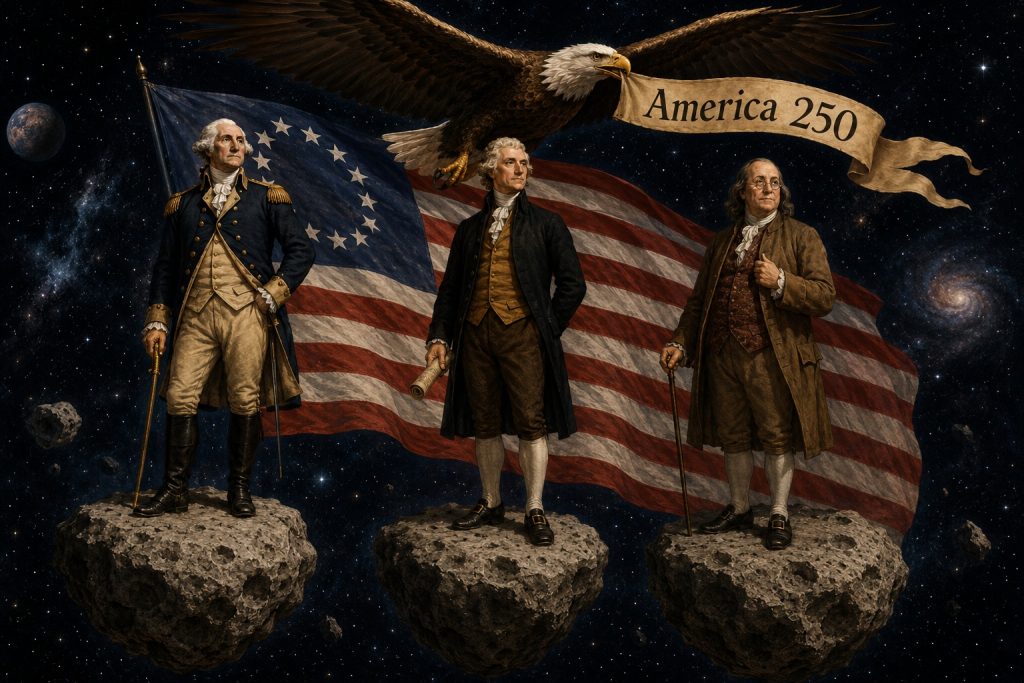
America 250: Founding Asteroids
By Alex Miller
In part one of this series on the US’ 250th birthday celebrations, we looked at asteroid America in the Declaration of Independence chart, and in the charts of some of the Founding Fathers. But it’s a two-way celestial street, and just as America appears prominently in the charts of the men who brought it into being, so, too, do asteroids representing those pivotal men appear conspicuously in the chart of the nation.
Take George Washington, for example, commander of the Colonial forces, victor of the Revolution, and the first American president, denominated “Father of his Country.” Washington strides across his countrymen’s imagination like a colossus, and that’s no surprise, given that asteroid Washingtonia (0 Taurus), a point named for him, appears opposed asteroid America (27 Libra) in the Declaration chart. The opposition (180 degrees) is a reflective aspect, wherein the opposed forces mirror one another – Washington is America, and America is Washington, even naming its capital in his honor.
Just for good measure, the cosmos provides asteroid George (27 Aries), exactly opposed America. George has been the first name of three American presidents, Washington and both Bushes, which between them helmed the nation for 20 years, 8% of the total.
But when we’re talking prominent monikers among US presidents, nothing beats James. No less than six Jameses have led the US, from Colonial-era Madison and Monroe, through Polk, Buchanan and Garfield in the mid-late 19th century, and James “Jimmy” Carter in the 20th, an impressive combined 29-year reign comprising 12% of US history. And asteroid James (23 Aries) is dutifully present, also opposed America. Many Jameses have been pivotal, including James Madison, the fourth president, author of the US Constitution; James Monroe, fifth president, of Doctrine fame, who first flexed US muscle on the world stage by warning off imperial powers from adding additional territories carved from the western hemisphere; and James Polk, America’s eleventh president, who expanded the size of the nation by some 525,000 square miles, when he annexed Texas and wrested the Southwest and California from Mexico in war.
That figure pales in comparison to the Louisiana purchase, inked by Thomas Jefferson, the third president, who managed to nab some 530,000,000 acres (more than 828,000 square miles) from an impoverished Napoleon Bonaparte, for a mere $15 million, gaining access to the Pacific Ocean in the process. Jefferson is also immortalized in the heavens with an eponymous asteroid Jefferson (14 Capricorn), named for him, which exactly squares (90 degrees) the US Saturn (14 Libra) and opposes its Sun (13 Cancer). Surely, Jefferson was instrumental in the nation’s inception and development (Sun), as the architect (Saturn) of the Declaration of Independence, an early ambassador of the country abroad, and the man who doubled its size in a single throw.
We’ve skipped lightly over John Adams, America’s second president, but we’ll rectify that now. An early champion of colonial independence and American unity, Adams was also a key figure in establishing diplomatic relations with European powers, serving as ambassador to France, The Netherlands, and Great Britian itself, following its recognition of American independence. He was also the first president to live in the newly constructed White House, the official residence of America’s chief executive. These connections are symbolized by asteroid Adams (18 Sagittarius), conjoined the Ascendant (12 Sagittarius), representing the public face of the country (in the manner of an ambassadorial role) and exactly squared asteroid Whitehouse (18 Virgo), as its first tenant. (Incidentally, Adams holds the distinction of being one of only two American presidents to have a son who also served, John Quincy Adams; the other is George H. W. Bush and son George W. Bush, both represented by asteroid Busch (13 Gemini), conjoined the opposing Descendant (12 Gemini).)
Benjamin Franklin is perhaps the most important figure from that period who never held high office. Seventy at the time of the Revolution, Franklin was a recognized global celebrity due to his experiments with electricity; the glue that bound together the Continental Congress, mediating between rival factions in the delegation; and the man who secured France’s financial and military support for the American cause. His pivotal role in American independence is expressed in the chart by asteroid Benjamina (16 Pisces), a feminine form of the name, at station (1), indicating a crisis, turning point or watershed moment has been reached. Points at station exert an influence much greater than typical, becoming formative, defining energies of the time. Asteroid Franklina (5 Libra) conjoins the Midheaven (1 Libra), the point of highest elevation in the chart, the focus of all eyes. This reflects Franklin’s international status and reputation (Midheaven), which granted the nascent nation a legitimacy and gravitas it would otherwise have lacked. Franklina is also trine (120 degrees) the US Uranus (8 Gemini), ruling electricity, a nod to what gave Franklin his fame.
Other significant figures from the Revolutionary period include John Hancock, president of the Second Continental Congress, which formalized the breach with Britain. Asteroid Hancock (26 Cancer) is named for him, and conjoins the Declaration’s Mercury (24 Cancer), with Hancock the man whose oversized signature (Mercury) was the first to be applied to the Declaration of Independence (as a document, also generally Mercury-ruled).
On the distaff side of the Revolution, we find Betsy Ross, the Philadelphia seamstress who sewed the first American flag, of thirteen stripes of red and white, and a circle of thirteen stars on a blue field. Ross is represented by asteroid Betsyglass (16 Gemini) conjoined asteroid Flagstaff (18 Gemini), combining a variation of her first name (2) with a referent for the flag she helped to create, also Angular on the US Descendant.
In part three of this series, we’ll look at additional significant individuals in American history, presidents and others, whose seminal roles seem to have been enfolded into the nation’s story from its inception.
Notes: (1) Stations are periods when, from our perspective on Earth, a planet appears to slow its movement, come to a standstill, and reverse course. This is an optical illusion created by the triangulation between the sun, Earth, and any third celestial body; astrologically, it represents a focusing of the energies associated with that point, and often coincides with major life events or a radical recalibration of how that point has functioned previously.
(2) Many asteroids are registered with the first and last names of the honored individual strung together as one word; these can be separated into their component parts and used for either, so Betsyglass is a useful referent for Betsys of all stripes.
Sources: historical data from Wikipedia; chart data from serennu.com
Title Image Credit: drawn by Chat GPT
Alex Miller
Alex Miller is a professional writer and astrologer, Editor-in-Chief of ANS, author of The Black Hole Book, detailing deep space points in astrological interpretation, and the forthcoming Heaven on Earth, a comprehensive study of asteroids, both mythic and personal. Alex is a frequent contributor to “The Mountain Astrologer”, “Daykeeper Journal”, and NCGR’s Journals and “Enews Commentary”; his work has also appeared in “Aspects” magazine, “Dell Horoscope”, “Planetwaves”, “Neptune Café” and “Sasstrology.” He is a past president of Philadelphia Astrological Society, and former board member for the Philadelphia Chapter of NCGR. His two decades of chronicling asteroid effects in human affairs can be found at his website, www.alexasteroidastrology.com.
Category:
Articles Asteroid Corner Tags: America 250, America 250 celebration, America 250 Founding Asteroids, American exceptionalism, American flag history, American founding astrology, American founding era, American heritage, American presidents named George, American Revolution astrology, asteroid Adams, asteroid America, asteroid Benjamina, asteroid Betsyglass, asteroid conjunctions, asteroid Franklina, asteroid George, asteroid Hancock, asteroid interpretation, asteroid James, asteroid Jefferson, asteroid oppositions, asteroid squares, asteroid stations, asteroid Washingtonia, asteroids in astrology, astrological aspects, astrology and history, astrology news, astrology of nations, astrology research, Benjamin Franklin astrology, Betsy Ross astrology, celestial history, celestial symbolism, colonial America, Continental Congress history, cosmic America, Declaration of Independence author, Declaration of Independence chart, Declaration of Independence signing, early American presidents, Father of His Country, Flagstaff asteroid, Founding Fathers astrology, founding fathers horoscope, founding generation, France and American Revolution, Franklin electricity experiments, George Washington and America, George Washington asteroid, George Washington astrology, historical astrology, James Madison astrology, James Monroe astrology, James Polk astrology, Jimmy Carter astrology, John Adams astrology, John Hancock astrology, Louisiana Purchase, mundane astrology, national horoscope, patriotic astrology, patriotic history, political astrology, revolutionary leaders, Revolutionary War astrology, Thomas Jefferson astrology, United States astrology, US bicentennial plus 50, US Constitution history, US independence, US natal chart, US Sun and Saturn, White House history
One thought on “America 250: Founding Asteroids”
Comments are closed.